
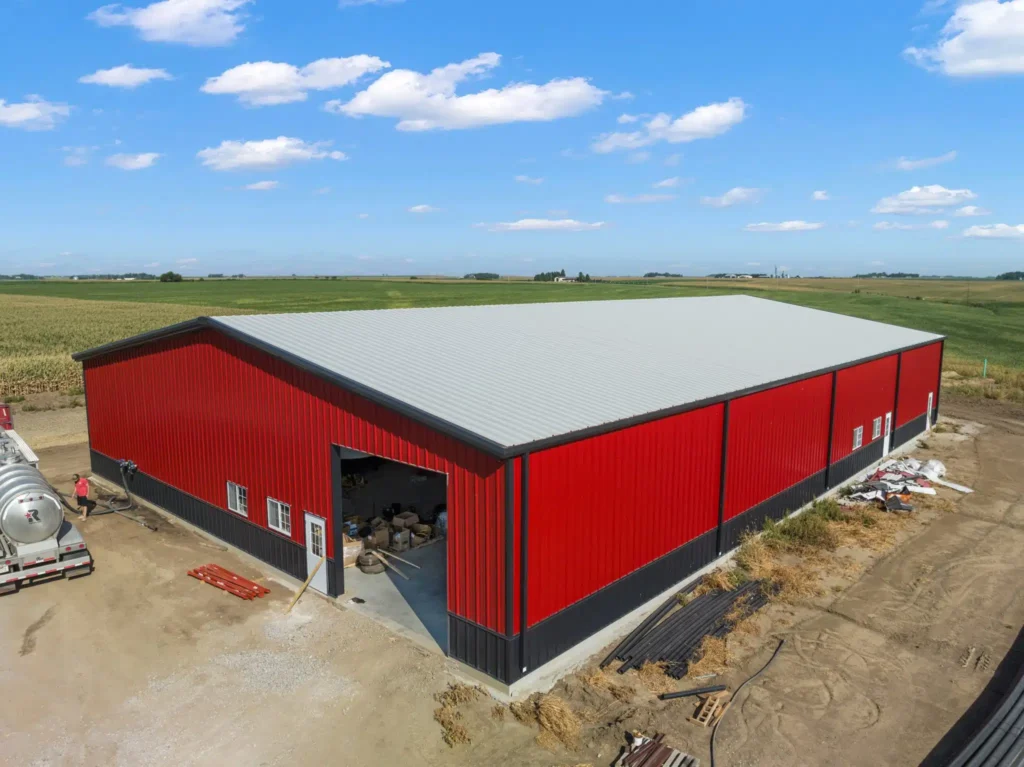
Across Ohio, farmers managing grain operations, livestock, hay production, and mixed agricultural businesses are building more pole buildings than ever before. The shift is not driven by trend, it is driven by practicality. Post-frame agricultural buildings deliver more usable space per dollar, go up faster than conventional construction, and stand up reliably to Ohio’s variable weather conditions over decades of hard use. For working farms where every dollar and every day matters, those advantages are significant.
Farm storage demands have increased as operations expand, and traditional construction methods often struggle to keep up in a way that remains cost-effective. Hay storage, equipment protection, grain handling, and livestock shelter all require purpose-built agricultural buildings that balance structural strength with functional efficiency. Pole buildings check every one of those boxes, which is why they have become the default building choice for serious farm operations throughout Ohio and the broader Midwest.
What Makes Pole Buildings a Better Fit for Ohio Farm Operations?
Ohio’s agricultural landscape is diverse, with operations ranging from small family farms to large-scale commercial grain and livestock producers. Pole buildings adapt to that range of needs without requiring custom engineering for every application. The post-frame structural system creates wide, column-free interiors that accommodate everything from combined storage to livestock housing, with layouts that can be configured based on how each operation actually functions.
The cost efficiency of pole buildings compared to conventional metal or masonry agricultural buildings is well documented. Lower foundation requirements, faster erection times, and simpler structural systems all reduce per-square-foot construction costs without sacrificing the structural performance that working agricultural buildings require. For Ohio farmers working within a capital budget, the ability to build more functional space at a lower cost per square foot is a straightforward and compelling reason to choose post-frame construction.
Why Is Hay Storage One of the Most Common Uses for Pole Buildings on Ohio Farms?
Hay storage is one of the most pressing and frequently cited reasons Ohio farmers invest in new agricultural buildings. Hay left exposed to moisture and weather loses nutritional value quickly, which directly affects livestock health and farm profitability. A well-built pole building designed specifically for hay storage eliminates these losses by keeping the product dry, ventilated, and protected from the elements throughout the season.
The structural requirements of hay storage buildings align well with what post-frame construction does best. High sidewalls, wide spans for equipment access, and ventilation provisions are all easily incorporated into a pole building design at a lower cost than comparable steel building systems. Farmers who have stored hay in open-sided structures or temporary shelters consistently report significant reductions in spoilage and waste after moving to a purpose-built hay storage building. That reduction in waste is a direct financial return on the construction investment.
How Do Pole Buildings Protect Farm Equipment and Machinery?
Farm machinery represents one of the largest capital investments on any Ohio farm, and protecting that investment with proper farm storage is one of the clearest financial decisions a farmer can make. Equipment left outside or in poorly sealed structures deteriorates faster, requires more maintenance, and experiences higher rates of weather-related mechanical problems. A purpose-built equipment pole building dramatically extends the working life of machinery by keeping it dry, shaded, and protected from freeze-thaw cycles.
Pole buildings designed for farm equipment storage can be configured with extra-tall doors to accommodate large combines and planters, wide bays for multi-machine storage, and concrete floors rated for the weight of heavy machinery. These practical design details make the building more functional for the daily demands of an operating farm. Spending a relatively small percentage of a machine’s value on proper farm storage consistently proves to be one of the highest-return investments a farm operation can make.
What Are the Structural Advantages of Pole Buildings in Ohio’s Climate?
Ohio experiences a full range of seasonal weather, from heavy snow loads in winter to high winds from spring and summer storms. Agricultural buildings need to be engineered for these conditions, and pole buildings designed to local code requirements handle Ohio’s climate demands reliably. Snow load ratings, wind resistance specifications, and roof pitch selection are all part of the engineering process for a properly designed post-frame agricultural building.
The post-frame system’s ability to transfer loads efficiently through widely spaced structural posts means that properly designed pole buildings resist racking from wind and deflection from snow weight without requiring excessive material. This structural efficiency does not compromise performance, it achieves it at a lower material cost. Ohio farmers who have built post-frame agricultural buildings in their operations consistently report durable, low-maintenance performance over many years of use in demanding conditions.
How Quickly Can an Agricultural Pole Building Be Constructed?
Construction speed matters on a farm where the building schedule has to work around planting, harvest, and livestock care demands. Pole buildings erect faster than conventional construction methods because the structural system is simpler, prefabricated components reduce on-site cutting and assembly time, and fewer subcontractor phases are required during the structural build. A standard agricultural building can often progress from foundation work to an enclosed shell within a few weeks, depending on size and complexity.
Faster construction means less disruption to farm operations during the build phase. Equipment that needs to be moved to clear the construction site can return sooner, and the new farm storage space becomes available faster. For a farm managing a tight operational calendar, this speed advantage is a practical benefit that carries real daily value. Working with an experienced post-frame builder who manages materials and scheduling efficiently keeps the project on track and minimizes downtime.
Can Pole Buildings Be Expanded as Farm Operations Grow?
Farm operations grow over time, and the buildings that support them need to keep pace. One of the practical advantages of post-frame agricultural buildings is that they can be expanded by adding bays to the existing structure without major structural disruption. A hay storage building that starts at one size can be extended as the herd grows or hay production increases, using the same structural system and similar materials to maintain a consistent finished appearance.
Planning for expansion at the initial design stage makes future additions even simpler. Working with a builder to identify logical expansion zones and ensuring the original structure’s framing accommodates future connections reduces costs and construction time when the expansion is eventually built. Delmarva Buildings designs agricultural buildings with the client’s long-term operational plans in mind, so the structure they build today supports growth without requiring a complete rebuild tomorrow.
Also Read: Why Do Pole Buildings Use Steel Roofing?
Why Are More Ohio Farmers Choosing Post-Frame Over Metal Building Kits?
Metal building kit systems are sometimes promoted as the most affordable option for farm storage, but the total cost comparison often shifts when all factors are considered. Kit systems frequently require additional engineering and site-specific modifications that are not included in the base price. The coordination demands of managing a kit delivery, contractor sourcing, and construction sequencing can also add time and expense that are not visible in the initial quote.
Post-frame agricultural buildings built by an experienced contractor deliver a complete, engineered, permitted, and constructed result that accounts for local code requirements, site-specific conditions, and the farmer’s operational needs from the beginning. The finish quality, structural integrity, and ongoing support of working with a builder who stands behind the project are factors that Ohio farmers weigh heavily when making a long-term infrastructure decision. For agricultural buildings that will be in service for thirty or forty years, build quality and accountability matter more than the lowest-possible initial price.
Also Read: Are Barndominium Kits a More Affordable Alternative to Custom Builds?
Conclusion
Ohio farmers are choosing pole buildings for agricultural buildings, hay storage, and farm storage in greater numbers because the practical case for post-frame construction is straightforward and well proven. Lower per-square-foot costs, faster construction timelines, wide-span interiors, and long-term structural performance in Ohio’s climate all make post-frame the sensible choice for farm infrastructure investments that need to perform reliably for decades.If you are an Ohio farmer evaluating options for a new agricultural building, the best approach is a direct conversation with a builder who understands farm operations and local construction requirements. Delmarva Buildings specializes in post-frame agricultural buildings designed for the way farms actually work, and getting a realistic project assessment is a practical first step toward making the right building decision for your operation.