
One of the most common questions homeowners and farm owners ask after their building is up is whether pole barn gutter systems are worth adding. It is easy to see gutters as an optional extra, but the water coming off a wide metal roof has to go somewhere, and where it lands has a direct effect on how long your building lasts. Understanding what gutters do, and which type suits your building, helps you protect your investment for years to come.
At Delmarva Buildings, we have designed and built post-frame structures across Delaware, Maryland, Virginia, New Jersey, and Ohio since 1999, and gutters come up in almost every conversation about long-term durability. This guide explains when gutters matter, what happens without them, and which gutter options tend to perform best on a pole building.
Do you need gutters on a pole barn?
In most cases, yes, a pole barn benefits from gutters, though it depends on your site and how you use the building. Gutters collect the rainwater that sheds off the roof and route it away from the base of your walls and posts, which is where uncontrolled runoff causes the most damage over time.
A large metal roof moves a surprising volume of water during a storm. Without a gutter system, that water falls straight to the ground along the drip line, splashes back onto the siding, and pools near the foundation. On sites with a slab or on ground that does not drain quickly, this is where erosion, staining, and moisture problems begin. If your building sits on well-draining, sloped ground far from anything you care about, you may get by without gutters. For most buildings near a home, driveway, paddock, or garden, they are a practical safeguard rather than a luxury.
What happens to a pole barn without gutters?
Without gutters, roof runoff concentrates along the base of the building and works against it in a few predictable ways. The first is soil erosion. Repeated splashing carves a trench along the drip line and can undermine the grade around your posts and slab.
The second is moisture near the posts and siding. Post-frame buildings rely on protected, dry conditions at the base of the columns, and constant water exposure raises the risk of decay and staining. Splash-back also drives dirt and moisture onto the lower panels, which shortens the good looks of your siding and can contribute to corrosion at the wall base. Poor drainage can even affect the ground beneath a concrete floor. Gutters do not fix every drainage issue, but by capturing water at the roof edge and carrying it away through downspouts, they remove the single biggest source of foundation and base-of-wall problems.
Also Read: Best Pole Barn Uses on Maryland’s Eastern Shore
What type of gutter works best for a pole barn?
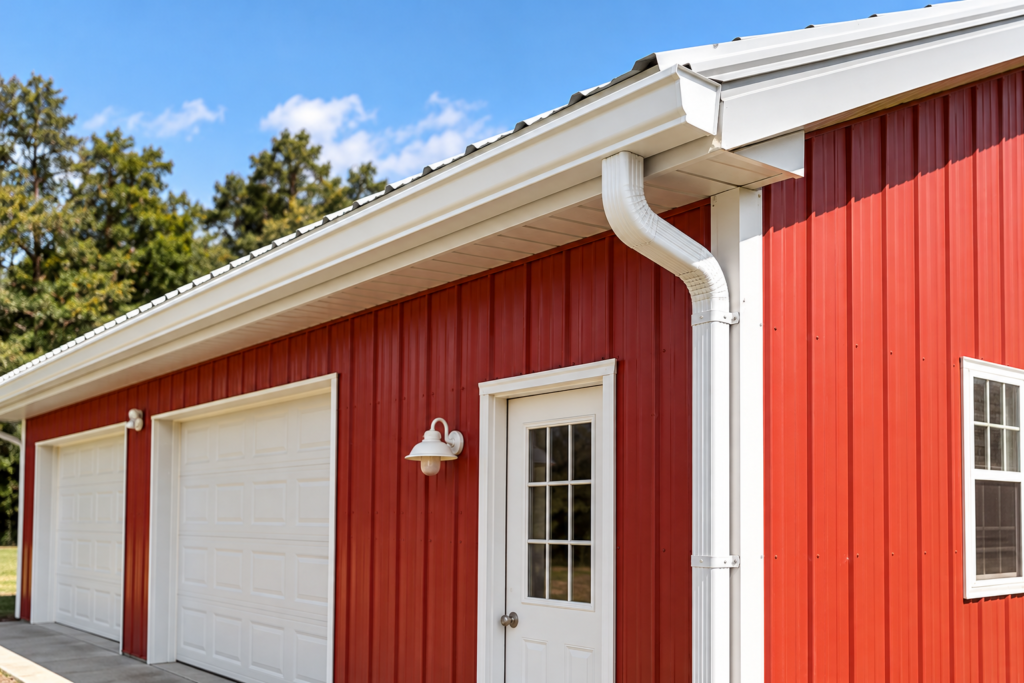
For most pole buildings, seamless aluminum gutters in a 5-inch or 6-inch K-style profile are the practical choice, with 6-inch preferred on larger roofs. The right size depends on your roof area and pitch, because a bigger roof sheds more water and needs more capacity to keep up with heavy rain.
Here is how the common options compare:
| Gutter type | Best for | Notes |
| Seamless aluminum (K-style) | Most residential and farm pole buildings | Fewer joints means fewer leaks, custom cut on site, low maintenance |
| Sectional aluminum or vinyl | Smaller buildings, tighter budgets | More seams to seal and maintain over time |
| Steel or galvanized | Heavy-use and agricultural settings | Strong and impact resistant, watch for corrosion at joints |
| Half-round | Appearance-driven and residential styling | Classic look, often paired with finished buildings |
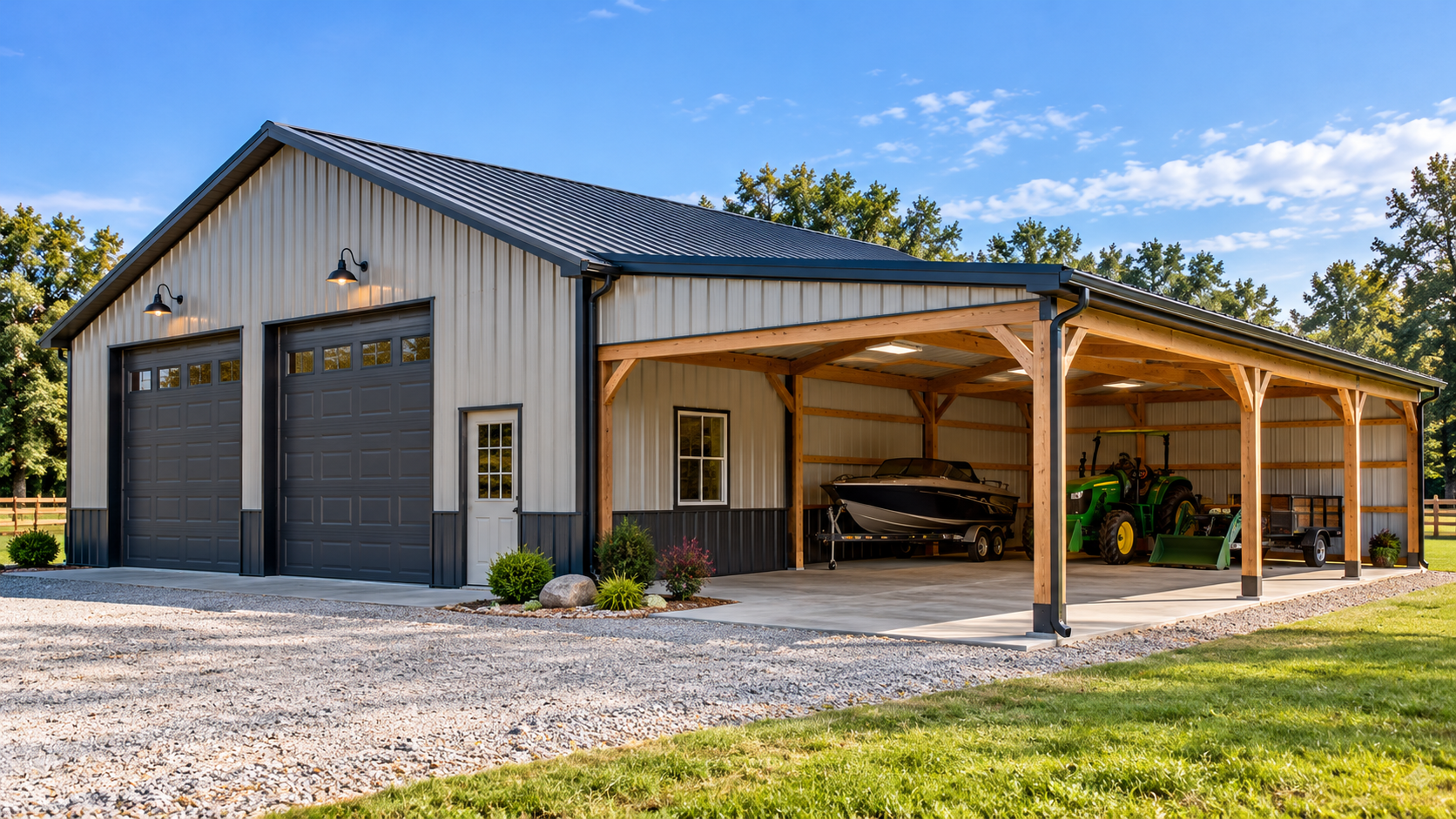
Because pole barns almost always have metal roofs, the gutter has to be sized for a fast, high-volume shed of water, and it must be hung with brackets rated for that load. Snow and ice sliding off a metal roof can also stress a gutter, so proper bracket spacing and placement matter. Matching the gutter color to your trim keeps the finished look clean, which is worth considering on a home, a custom garage, or any building where appearance counts.
Does the local climate change what you need?
Local conditions on the Delmarva Peninsula and across the Mid-Atlantic make gutters more valuable, not less. This region sees heavy seasonal rain, coastal humidity, and periodic strong storms, all of which increase the volume and force of roof runoff. On the Eastern Shore of Maryland and in low-lying areas, controlling water at the roof edge is one of the simpler ways to protect a building over its life.
Downspouts and where they discharge matter as much as the gutter itself. Water should be carried well away from the building and, where possible, tied into a drainage plan so it does not simply pool a few feet from the wall. On agricultural sites, gutters can also be paired with rainwater collection for livestock or irrigation, which turns runoff into a resource. If you are planning a new farm and ag building or a residential pole building, it is worth deciding on gutters and grading early rather than adding them as an afterthought.
Can you add gutters to an existing pole barn?
Yes, gutters can be added to a building that is already standing, and this is a common upgrade. The key is confirming that the fascia or eave detail can carry the brackets, and that the gutter is sized correctly for the roof. On some older buildings, the eave trim may need attention before a gutter is hung so it drains properly and stays sealed.
If your existing building has shown signs of base-of-wall moisture, staining, or erosion, gutters are often part of the fix. In cases where the roof edge or panels have also been affected, a builder may recommend addressing the metal roofing at the same time so the whole edge detail works together. Handling it as one project usually gives a cleaner, longer-lasting result than piecing it together later.
Conclusion
Pole barn gutter systems are a small addition that protects a large investment. They control roof runoff, reduce erosion and base-of-wall moisture, and help your building age well, which matters even more in the wet, humid conditions common across Delaware, Maryland, and Virginia. For most buildings, a correctly sized seamless aluminum gutter with well-placed downspouts is the practical choice.
The best time to plan gutters and site drainage is alongside the building itself, but they can also be added later as a smart upgrade. If you would like guidance on the right gutter approach for your building and site, you can request a free quote and talk it through with a builder who works across the region.
In most cases, yes. Gutters collect roof runoff and carry it away from the base of the walls and posts, which reduces erosion, splash-back, and moisture near the foundation. Buildings on flat or poorly draining sites, or near a home or driveway, benefit the most.
A 5-inch or 6-inch K-style gutter is common, with 6-inch preferred on larger roofs that shed more water. The right size depends on your roof area and pitch, so a builder should size the system to your specific building.
Seamless aluminum gutters have fewer joints, which means fewer places to leak and less maintenance over time. Paired with correctly rated brackets for a metal roof, they tend to be a reliable, low-maintenance choice.
Yes. Gutters can be retrofitted to most existing buildings, provided the eave detail can support the brackets and the gutter is sized for the roof. If there is existing moisture or roof-edge damage, it is worth addressing those together.