
Doors are one of the first decisions that shapes how a pole building actually works day to day. For many owners, the choice comes down to sliding doors versus overhead doors, and it is worth understanding the trade-offs before you order. Pole barn sliding doors have been a staple of post-frame buildings for decades, and for good reasons, but they are not the right fit for every building.
Delmarva Buildings has designed post-frame structures across Delaware, Maryland, Virginia, New Jersey, and Ohio since 1999, and door selection comes up on nearly every project. This guide explains how sliding doors work, when they are the better choice, what to know before you order, and which buildings they suit best, so you can decide with confidence.
What are pole barn sliding doors and how do they work?
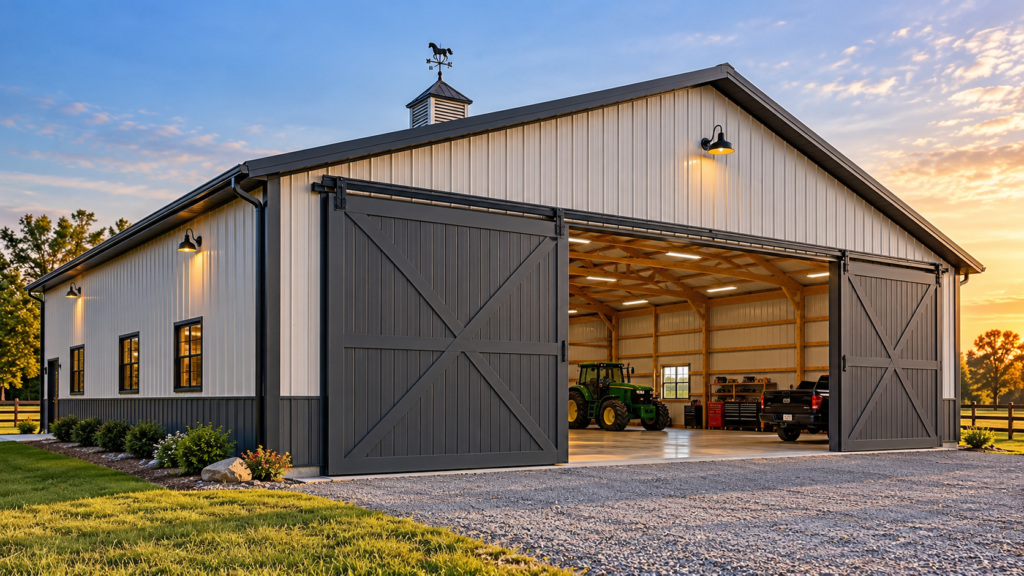
Pole barn sliding doors are large doors that hang from a track along the top and slide horizontally to open, rather than lifting up like an overhead door. They are a traditional, proven option for post-frame buildings, especially where wide openings are needed.
The door panels roll along a top track mounted to the building, guided at the bottom to stay aligned, and slide to one or both sides. Because they do not use overhead springs, motors, or ceiling tracks, sliding doors are mechanically simple, which is part of their long-standing appeal. They can be built to cover very large openings, which makes them well suited to buildings that need to move big equipment in and out. That simplicity also means fewer moving parts to maintain over the years, though there are trade-offs in sealing and weather resistance that are worth understanding before you commit.
When should you choose sliding doors over overhead doors?
Choose sliding doors when you need a wide, tall opening, want a simple and durable door, and do not require a tight weather seal or automatic operation. They shine on working buildings where big equipment access and low maintenance matter more than climate control.
Here is how the two options compare at a glance:
| Factor | Sliding doors | Overhead doors |
| Opening size | Excellent for very wide openings | Good, but limited by size and hardware |
| Ceiling and interior space | Needs no ceiling track, keeps interior clear | Uses ceiling and overhead space |
| Weather sealing | Looser seal, less airtight | Tighter seal, better for insulated space |
| Operation | Manual by default, simple | Easy to automate with an opener |
| Maintenance | Few moving parts | More hardware to maintain |
| Cost | Often lower for large openings | Can cost more, especially insulated |
Sliding doors tend to win for agricultural buildings, equipment storage, and large open structures. Overhead doors are usually the better choice for insulated, climate-controlled, or finished spaces where sealing and automatic operation matter, such as a heated custom garage. Many buildings use a mix, with sliding doors for large equipment access and an overhead or walk door for everyday use.
Also Read: Best Pole Barn Uses on Maryland’s Eastern Shore
What should you know before ordering pole barn sliding doors?
Before you order, get the sizing, sealing, and hardware right, because these decide how well the door performs for years. A sliding door that is sized and detailed correctly is a pleasure to use, while a poorly specified one becomes a daily frustration.
Key points to confirm with your builder include the opening size and how the door will split, since very wide openings often use a bi-parting design that slides to both sides. Weather sealing is the main trade-off to plan for, because sliding doors are naturally less airtight than overhead doors, and brushes or seals can improve this. Track and hardware quality matters for smooth, long-term operation, especially on heavy doors. Wind exposure is a real consideration in the Mid-Atlantic, so the door and its guides need to handle local wind loads and stay aligned. Insulation is possible but limited compared with a sealed overhead door, so if climate control is a priority, weigh that carefully. Planning these building options and features up front, rather than adjusting later, gives the best result.
Which buildings suit sliding doors best?
Sliding doors are best suited to buildings that prioritize wide access, durability, and simplicity over tight climate control. Their strengths line up closely with the needs of working post-frame structures.
Agricultural and equipment buildings are the classic fit, since they often need very wide openings for tractors, trailers, and machinery, which is exactly where sliding doors excel. A farm and ag building frequently uses one or more large sliding doors for this reason. Equestrian buildings also commonly use them, as they allow easy movement of animals and equipment with a simple, reliable design. Large storage and general-purpose barns benefit from the wide, unobstructed opening and low maintenance. Buildings where a tight seal, insulation, or automatic operation is essential, such as finished or heated spaces, usually lean toward overhead doors instead. The right answer depends on how you will use the building day to day.
Also Read: Types of Pole Buildings in Delaware & Maryland
Conclusion
Pole barn sliding doors are a proven, practical choice, and they are often the best option for buildings that need wide equipment access, durability, and simple operation. Where they fall short is tight weather sealing and easy automation, which is where overhead doors take the lead, so the right decision comes down to how you will actually use the building. Getting sizing, sealing, and hardware right before you order is what separates a door you love from one you fight with.
If you are weighing sliding doors against other options for a farm, equestrian, storage, or general-purpose building, the best next step is a conversation about your specific layout. You can request a free quote and plan your doors with a builder who works across the region.
Neither is universally better; it depends on how you use the building. Sliding doors suit wide openings, equipment access, and simple, low-maintenance operation, while overhead doors suit insulated, climate-controlled, or finished spaces that need a tighter seal and easy automation.
Sliding doors are naturally less airtight than overhead doors because of how they hang and slide. Brushes and weather seals improve them, but if a tight seal or climate control is essential, an overhead door is usually the better fit.
Sliding doors can cover very wide openings, which is one of their main advantages, and large openings often use a bi-parting design that slides to both sides. The right size and configuration should be confirmed with your builder based on the building and its use.
Yes, when they are specified for local wind loads with quality track, guides, and hardware. Wind exposure is a real consideration across Delaware, Maryland, and Virginia, so proper detailing keeps the door aligned and operating well.